Showing posts with label Castle. Show all posts

March 28, 2013

Kilkenny Castle

Kilkenny Castle (Irish: Caisleán Chill Chainnigh) is a castle in Kilkenny, Ireland built in 1195 by William Marshal, 1st Earl of Pembroke to control a fording-point of the River Nore and the junction of several routeways. It was a symbol of Norman occupation and in its original thirteenth-century condition it would have formed an important element of the defences of the town with four large circular corner towers and a massive ditch, part of which can still be seen today on the Parade.
The property was transferred to the people of Kilkenny in 1967 for £50 and the castle and grounds are now managed by the Office of Public Works. The gardens and parkland adjoining the castle are open to the public. The Parade Tower is a conference venue. Awards and conferring ceremonies of the graduates of "Kilkenny Campus" of National University of Ireland, Maynooth have been held there since 2002.


March 25, 2013

Agra Fort

Agra Fort, is a monument, ‎ a UNESCO World Heritage site located in Agra, Uttar Pradesh, India. It is about 2.5 km northwest of its more famous sister monument, the Taj Mahal. The fort can be more accurately described as a walled city.
Agra Fort was originally a brick fort, held by the Hindu Sikarwar Rajputs. It was mentioned for the first time in 1080 AD when a Ghaznavide force captured it. Sikandar Lodi (1488–1517) was the first Sultan of Delhi who shifted to Agra and lived in the fort. He governed the country from here and Agra assumed the importance of the second capital. He died in the fort at 1517 and his son, Ibrahim Lodi, held it for nine years until he was defeated and killed at Panipat in 1526. Several palaces, wells and a mosque were built by him in the fort during his period.


April 4, 2012

Neuschwanstein Castle

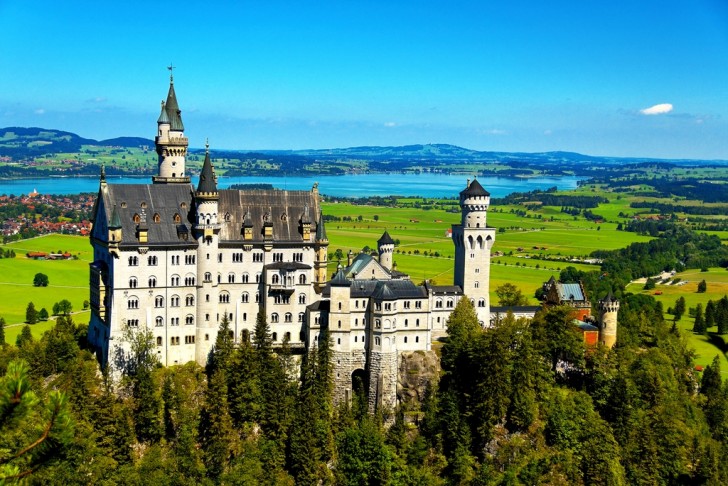
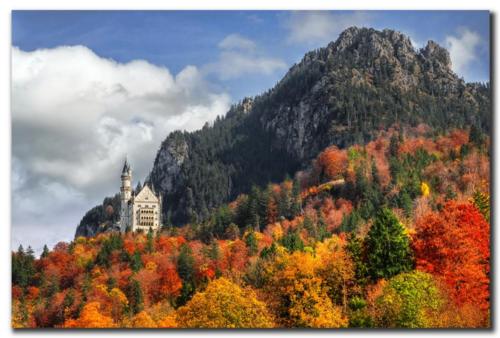
Neuschwanstein Castle is a 19th-century Romanesque Revival palace on a rugged hill above the village of Hohenschwangau near Füssen in southwest Bavaria, Germany. The palace was commissioned by Ludwig II of Bavaria as a retreat and as a homage to Richard Wagner. Contrary to common belief, Ludwig paid for the palace out of his personal fortune and extensive borrowing, not with Bavarian public funds.
The palace was intended as a personal refuge for the reclusive king, but it was opened to the paying public immediately after his death in 1886. Since then over 60 million people have visited Neuschwanstein Castle. More than 1.3 million people visit annually, with up to 6,000 per day in the summer. The palace has appeared prominently in several movies and was the inspiration for Disneyland's Sleeping Beauty Castle and later, similar structures.


The municipality of Schwangau lies at an elevation of 800 m (2,620 ft) at the south west border of the German state of Bavaria. Its surroundings are characterized by the transition between the Alpine foothills in the south (towards the nearby Austrian border) and a hilly landscape in the north that appears flat by comparison. In the Middle Ages, three castles overlooked the village.
One was called Schwanstein Castle. In 1832, Ludwig's father King Maximilian II of Bavaria bought its ruins to replace them by the comfortable neo-Gothic palace known as Hohenschwangau Castle. Finished in 1837, the palace became his family's summer residence, and his elder son Ludwig (born 1845) spent a large part of his childhood here.
Vorderhohenschwangau Castle and Hinterhohenschwangau Castle sat on a rugged hill overlooking Schwanstein Castle, two nearby lakes (Alpsee and Schwansee), and the village. Separated only by a moat, they jointly consisted of a hall, a keep, and a fortified tower house. In the 19th century only ruins remained of the medieval twin castles, but those of Hinterhohenschwangau served as a lookout place known as Sylphenturm.
 The ruins above the family palace were known to the crown prince from his excursions. He first sketched one of them in his diary in 1859. When the young king came to power in 1864, the construction of a new palace in place of the two ruined castles became the first in his series of palace building projects. Ludwig himself called the new palace New Hohenschwangau Castle – only after his death was it renamed Neuschwanstein. The confusing result is that Hohenschwangau and Schwanstein have effectively swapped names: Hohenschwangau Castle replaced the ruins of Schwanstein Castle, and Neuschwanstein Castle replaced the ruins of the two Hohenschwangau Castles.


Related Posts Plugin for WordPress, Blogger...