Showing posts with label Italy. Show all posts

April 11, 2012

Pisa

Pisa  is a city in Tuscany, Central Italy, on the right bank of the mouth of the River Arno on the Tyrrhenian Sea. It is the capital city of the Province of Pisa. Although Pisa is known worldwide for its leaning tower (the bell tower of the city's cathedral), the city of over 88,332 residents (around 200,000 with the metropolitan area) contains more than 20 other historic churches, several palaces and various bridges across the River Arno.
The city is also home of the University of Pisa, which has a history going back to the 12th century and also has the mythic Napoleonic Scuola Normale Superiore di Pisa and Sant'Anna School of Advanced Studies as the best Superior Graduate Schools in Italy


.

February 23, 2012

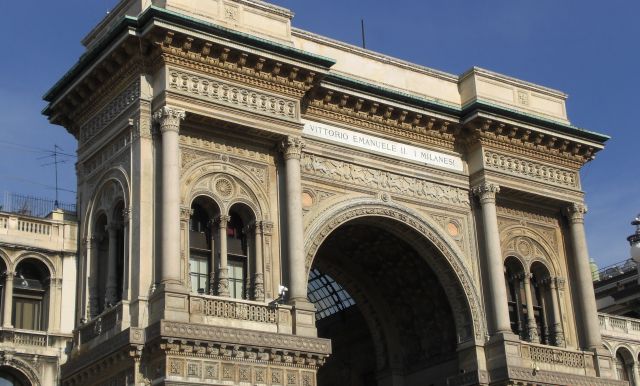
Galleria Vittorio Emanuele II ( MILAN)

The Galleria Vittorio Emanuele II is a double arcade in the center of Milan, Italy. The structure is formed by two glass-vaulted arcades intersecting in an octagon covering the street connecting Piazza del Duomo to Piazza della Scala.
The Galleria is named after Vittorio Emanuele II, the first king of the Kingdom of Italy. It was originally designed in 1861 and built by Giuseppe Mengoni between 1865 and 1877.
The street is covered by an arching glass and cast iron roof, a popular design for nineteenth-century arcades, such as the Burlington Arcade in London, which was the prototype for larger glazed shopping arcades, beginning with the Saint-Hubert Gallery in Brussels (opened in 1847), the Passazh in St Petersburg (opened in 1848), the Galleria Umberto I in Naples (opened in 1890) and the Budapest Galleria.
The central octagonal space is topped with a glass dome. The Milanese Galleria was larger in scale than its predecessors and was an important step in the evolution of the modern glazed and enclosed shopping mall, of which it was the direct progenitor. It has inspired the use of the term galleria for many other shopping arcades and malls.
In the central mosaic there is a depiction of the bull from Turin Coat of Arms. The tradition tells that if a person put its right heel on the bull's genitals and turn on himself three times, this will bring good luck. This practice causes damage to the mosaic: a hole developed on the place of the bull's genitals.
The Galleria connects two of Milan's most famous landmarks: The Duomo and the Teatro Alla Scala, but the Galleria is a landmark on its own right.


The Galleria is often nicknamed il salotto di Milano (Milan's drawing room), due to its numerous shops and importance as a common Milanese meeting and dining place.
More than 130 years after its inauguration, the four-story arcade includes elegant shops selling most things from haute couture and jewelry to books and paintings, as well as restaurants, cafés, and bars. The Galleria is famous for being home to some of the oldest shops and restaurants in Milan, such as the historic Biffi Caffè, founded in 1867 by Pastry Chef to His Majesty Paolo Biffi and (in 1882) the first Milanese café to install electric lighting, the Savini restaurant, the silverware store Bernasconi and the Art Nouveau classic Zucca's Bar.
Today, the Galleria is the site for many luxury goods shops, including Prada, Massimo Dutti, Gucci and Louis Vuitton, as well as fast food restaurants such as McDonald's


.

January 13, 2011

Ponte Vecchio (Italy): Oldest and famous bridge

Ponte Vecchio

The bridge spans the Arno at its narrowest point where it is believed that a bridge was first built in Roman times, when the via Cassia crossed the river at this point. The Roman piers were of stone, the superstructure of wood. The bridge first appears in a document of 996. After being destroyed by a flood in 1117 it was reconstructed in stone but swept away again in 1333 save two of its central piers, as noted by Giovanni Villani in his Nuova Cronica. It was rebuilt in 1345, Giorgio Vasari recorded the tradition in his day, that attributed its design to Taddeo Gaddi, besides Giotto one of the few artistic names of the trecento still recalled two hundred years later. Modern historians present Neri di Fioravanti as a possible candidate. Sheltered in a little loggia at the central opening of the bridge is a weathered dedication stone, which once read Nel trentatrè dopo il mille-trecento, il ponte cadde, per diluvio dell' acque: poi dieci anni, come al Comun piacque, rifatto fu con questo adornamento. The Torre dei Mannelli was built at the southeast corner of the bridge to defend it.
The bridge consists of three segmental arches: the main arch has a span of 30 meters (98 ft) the two side arches each span 27 meters (88 ft). The rise of the arches is between 3.5 and 4.4 meters (11½ to 14½ feet), and the span-to-rise ratio 5:1.
It has always hosted shops and merchants who displayed their goods on tables before their premises, after authorization of the Bargello (a sort of a lord mayor, a magistrate and a police authority). The back shops (retrobotteghe) that may be seen from upriver, were added in the seventeenth century.


source: en.wikipedia.org/wiki/Ponte_Vecchio

December 29, 2010

Duomo, Milan Cathedral (Milan, Italy)

Milan Cathedral (Italian: Duomo di Milano; Milanese: Domm de Milan) is the cathedral church of Milan in Lombardy, northern Italy. Dedicated to Santa Maria Nascente (Saint Mary Nascent), it is the seat of the Archbishop of Milan, currently Cardinal Dionigi Tettamanzi.
The Gothic cathedral took five centuries to complete. It is the largest Gothic cathedral and the second largest Catholic cathedral in the world.


source: en.wikipedia.org/wiki/Milan_Cathedral
Related Posts Plugin for WordPress, Blogger...